
Dental implants offer numerous benefits beyond just improving appearance. With the technology we have today, it is possible to see and experience the end result before treatment begins.
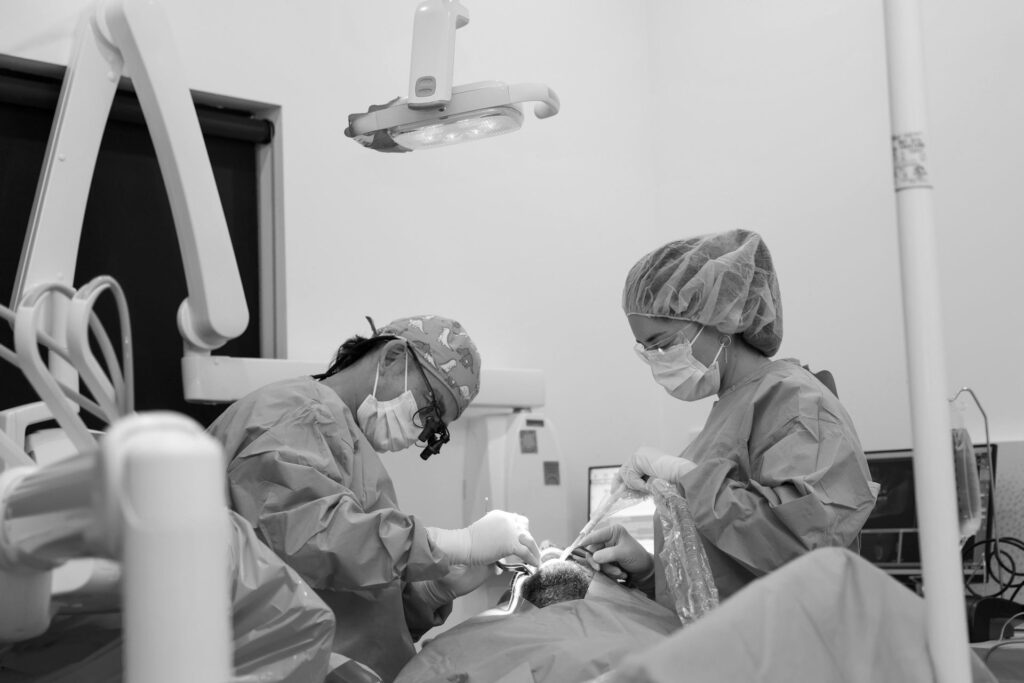
With his experience in dental implant therapy, Dr Chan will explain all the options available to you in a complimentary personal consultation.
Step
1
A complimentary private consultation with Dr Chan is the only way to answer the questions unique to you;
Step
2
With premium materials and computer-aided surgical guidance, the first part is your surgery. You will walk out with a smile, knowing that it’ll lead to an another that is even more beautiful.
Step
3
Our ongoing support and advanced dental solutions are designed to help you maintain the longevity of your beautiful smile.
*remains the property of South St Dental, but available for purchase should you require
Please note that you will be seeing Dr Chan for this appointment, a “no-show” fee will apply in accordance with our booking/cancellation policy.
All implant treatment costs will differ based on your unique requirements. Generally there are two components that make up the total cost – the type and number of implants, and the type of material you choose for the crowns (the teeth).
Price guide for cost of a single dental implant at South Street Dental;
We take pride in being transparent with our pricing and what it involves during our discussions. You will always understand what you are paying for and the reason for it.
We believe education will empower you to ask relevant questions and make more accurate comparisons.
Contact us today to book your free initial consultation or to find out more about dental implant treatment and how it could improve your quality of life.
Implant treatment and other complex surgery is ideally performed in theatre at our affiliated hospital, Southbank Day Surgery, where Dr Henry Chan is a registered dental specialist. Medicare rebates may apply.
In many cases, private health policies will cover the cost of theatre for essential dental procedures in an approved hospital. We can help enquire on your behalf.
Southbank Day surgery is a Medibank member’s choice hospital and also a HBF Member’s Plus provider.
We have various payment plan options to allow you to begin treatment at your convenience and manage costs over time.
Where the benefit of early intervention is recognised, you may be eligible to access your Super early. Supercare has been providing Compassionate Super access support to Australians for over 13 years.
Dr Henry Chan has been an advocate of dental implants since 2006 as a way of fundamentally improving the quality of life for his patients. He has devoted his professional life not only to the study and practice of implant placement, bone and sinus graft surgery but also to advanced biological therapies.
His extensive specialist education continually exceeds the state’s requirements and he has completed postgraduate courses in London, Paris and Brazil. He is one of few that hold a Masters of Oral Implantology from the prestigious Goethe University in Frankfurt.
Dental implants are artificial tooth ‘roots’ that provide a permanent base for fixed or removable replacement teeth.
Key Components:
See all elements of a dental implant or learn more about the types of dental implants here.
Choosing implants not only improves your ability to eat and speak comfortably but also contributes to better mental health. Regaining control in this situation is a proactive approach to maintaining your smile and preventing future dental issues. If you’re considering a solution for missing teeth, dental implants present a compelling alternative to traditional dentures.
Improved Chewing Ability: Dental implants function like natural teeth, allowing you to eat a wider variety of foods without discomfort.
Better Speech: Unlike dentures, which can slip and cause slurred speech, implants help maintain clear pronunciation.
Jawbone Preservation: Implants stimulate the jawbone, preventing bone loss that typically occurs after tooth loss.
Preventing Facial Structure Changes: Maintaining bone density helps preserve your facial structure, avoiding a sunken appearance.
Long-Lasting Solution: With proper care, dental implants can last many years, often a lifetime, making them a cost-effective option in the long run.
No Need for Adhesives: Unlike dentures, implants don’t require messy adhesives.
Easy Maintenance: They can be cared for just like natural teeth—regular brushing and flossing.
Stable and Secure: Implants eliminate the discomfort associated with removable dentures, providing a more comfortable fit.
In dental implant therapy, it is the process where your bone tissue grows into and meshes with a placed implant. Good osseointegration is needed to securely anchor the implant in your jawbone.
A technique called “resonance frequency analysis” is used to measure the ISQ of an implant. ISQ is a number on a scale (from q to 100) that indicates the level of osseointegration of a dental implant. It is a standardised way to quantify the stability of the implant.
Bone grafting is necessary when there is insufficient jaw bone to accommodate the osseointegration of the implant. Insufficient bone may be a result of several years of a denture or partial denture. When teeth are missing, the jaw bone will thin out slowly over time from the lack of direct stimulation (ie pressure from chewing). Disease or an accident can also leave a larger hole than desired for dental implant placement. Click here for more information on bone grafting.
A sinus lift, or sinus augmentation may be required when you don’t have enough upper jawbone ‘height’ to accommodate the whole implant. This is a procedure to ‘raise’ the membrane of your sinus away from the jawbone, so the appropriate implant can be placed without penetrating the sinus structure. To find out how it’s done, click here.
Depending on why it is wobbly in the first place, immediate implant placement is possible. Firstly, a good dentist will determine if that tooth is able to be saved! So if you are in that situation, don’t wait, please see us ASAP. If an infection is present, it will be addressed first, and then we can determine and plan for an immediate implant if suitable.
No, not 20 individual implants. That’s the beauty of implant dentistry. With the technology and materials we have today, a whole prosthetic arch of teeth can be secured to your jaw with as little as 4 implants. Precise measurement and calculations will determine the optimal minimum number of implants for every case. Find out more about our ‘all-on-4’ (aka ‘all-on-x’) implant treatment here.
Dental implants involve surgical procedures and carry the normal risks of surgery including:
An implant is tested between eight and 24 weeks to determine if it has integrated with the jaw bone. Such failures are rare, particularly if the practitioner’s instructions are followed closely by the patient.
There is significant variation in integration failure rates due to individual risk factors.
The immediate placement of an implant after trauma or extraction may lead to a higher failure rate.
Long-term failures generally occur because of poor bone density, bone and gingival loss around the implant due to peri-implantitis (inflammation of the tissue around the implant) or the mechanical failure of the implant.
The common post-surgery side effects associated with dental implant surgery are:
A properly integrated implant can last many decades, though the more delicate crown may need to be replaced due to wear or accidental breakage. If an implant has failed then it should be removed and the cause of failure needs to be managed/treated.
Because dental implants are the closest replica to natural teeth, they need to be regularly checked and maintained like natural teeth.
A deteriorating oral environment may cause an implant to fail from persistent infection and inflammation. New conditions such as stress and anxiety leading to grinding may cause breakage due to uneven or unusually concentrated forces.
Sudden or uneven forces, such as the impact of an accident, (or a gob-stopper candy!), can result in fracturing of the bridgework or implant components.
The loss of bone adjacent to the implant can result in new point of contact of the bite, where the geometry of the implants no longer supports the load in the same way. Regular checkups and cleans are the easiest way to detect and manage any potential issues.
Precise imaging is essential for a diagnosis, hence we are happy to offer all necessary scans (from which to quote) for free, whether or not you decide to proceed with treatment.
This allows us to provide a detailed and accurate treatment plan tailored to your needs. We kindly ask for your understanding that these scans are part of our comprehensive assessment and remain our property. Should you wish to take them elsewhere, they can be purchased according to our set pricing. We hope you see this offer as a fair and valuable step towards achieving your dental goals.
Complete the form below and our team will get in touch to organise a time for your consulation.