
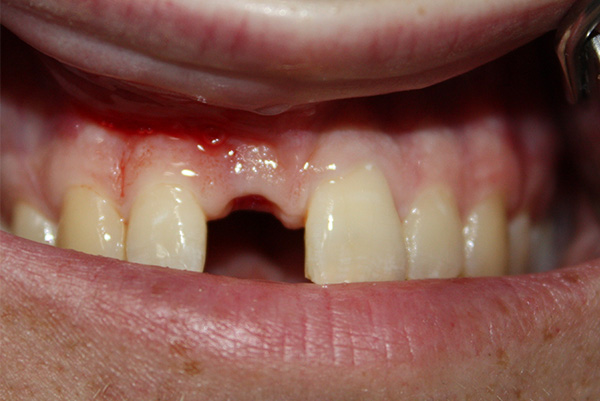
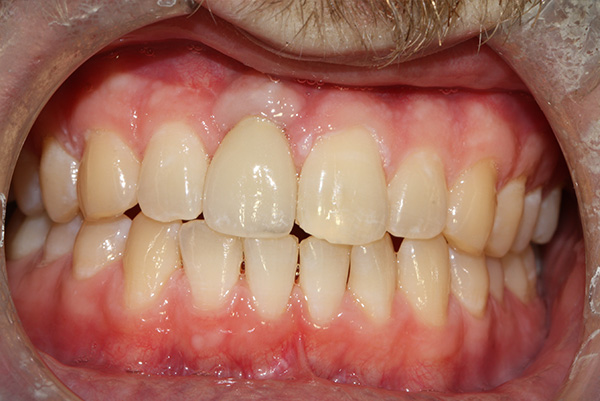
One of the main benefits of dental implants is that they can replace teeth, anchor dentures, and preserve jaw bone from atrophy to prevent facial collapse and premature ageing.
A dental implant offers significant benefits when compared with traditional crowns and dentures – in convenience, functionality and aesthetics. When placed by an experienced practitioner and with ongoing diligent hygiene maintenance, dental implants can last a lifetime.
Before and after photos of one of Dr Chan’s patients where a missing tooth was replaced with a dental implant.
Not just of your teeth, but your entire face. Dental implants can prevent premature ageing due to jaw bone loss and facial collapse.
Research shows more than 90% of implant patients experience a positive confidence boost.
Traditional dentures require constant work by the cheek and tongue muscles to keep them in place. Implants behave like permanent teeth so they don’t affect speech.
Unlike implants, even the best dentures will decrease eating efficiency. Dentures also don’t prevent bone loss; which will eventually render the patient unable to wear a denture.
Contact us today to book your initial consultation or to find out more about dental implant treatment and how it could improve your quality of life.
When teeth are knocked out or extracted (and not replaced with implants) the body will consider the jaw bone at the site of the missing teeth to be useless. It will begin to demineralise the bone, so as to re-use the minerals elsewhere in the body.
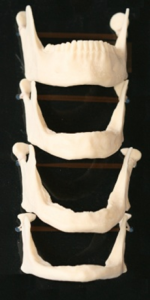
Over a period of ten to twenty years, the patient will end up with a condition called facial collapse which causes premature ageing. This loss of bone can increase the likelihood of fractures. It can also render the patient unable to wear a denture.
The top model on the right has all teeth present. The jaw bone is substantial and healthy.
Each succeeding model shows what happens to the jaw bone after all the teeth are removed.
The bone loss after 5, 10 and 15 years is startling.
A patient with a lower jaw similar to the last model would be a dental cripple; unable to wear a conventional denture.
In 2013, Straumann, an international dental implant manufacturer, published a review of 14 previous studies on dental implants.
The Straumann report found that implants are cost-effective for single and multiple tooth replacements, and when fitted properly, led to improved oral health and overall quality of life.
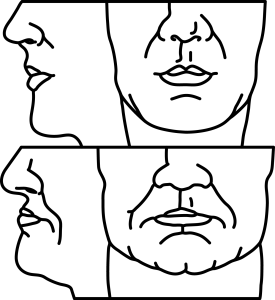
Facial collapse is a cause of premature ageing.
The diagram shows the facial changes that occur after wearing conventional dentures for years.
The lips sink and pucker and facial wrinkles become more prominent.
When dental implants are present, they stimulate the jaw bone and keep it from atrophying. This is called the piezoelectric effect.
The greater the number of dental implants placed, the greater the piezoelectric effect, and the better the protection against facial collapse.
The x-ray below illustrates this effect dramatically.
The patient is a 68-year-old female who has no natural teeth left. Fifteen years ago, the implants visible in the x-ray were placed in her lower front jaw.
There is clearly a still lot of bone present at the implant location, even as most of the bone in the rest of her mouth has atrophied. The implants have kept the bone stimulated.
If you have little or no jaw bone left, all is not lost. Long term comfort and function can be still restored using the following techniques:
Bone grafts:
Dental bone grafting material is used to increase the strength and aesthetics of the jaw bone.
Denture/implant hybrid restoration:
Lost bone and gum tissue are replaced with dental materials.
Optimal and precise implant placement:
The prospects of getting a solid, long-lasting result can be enhanced by carefully placing the implants in remaining solid areas of bone. These solid areas are identified thorough radiographic diagnosis.
Dr Chan has successfully rehabilitated the jaws of many patients. His success lies in his meticulous planning, skill and the use of computerised technology for precision implant placement.
Dr Henry Chan has been an advocate of dental implants since 2006 as a way of fundamentally improving the quality of life for his patients. He has devoted his professional life not only to the study and practice of implant placement, bone and sinus graft surgery but also to advanced biological therapies.
His extensive specialist education continually exceeds the state’s requirements and he has completed postgraduate courses in London, Paris and Brazil. He is one of few that hold a Masters of Oral Implantology from the prestigious Goethe University in Frankfurt.
Complete the form below and our team will get in touch to organise a time for your consulation.